The best position for erectile dysfunction is usually one where you lie back or on your side and your partner sets the pace, such as woman on top or spooning. No position fixes erections on its own, but these reduce effort and pressure. Erectile dysfunction is common and treatable, so treating its cause matters most.
This guide covers five positions that make sex easier, why erections often fade when you change position, practical tips, and the root causes worth checking. For the full medical picture, read our guide to the causes and treatment of erectile dysfunction.
Trying to last longer rather than stay firm? That is a different problem, and we cover it in sex positions for lasting longer (premature ejaculation).
Do sex positions help with erectile dysfunction?
Yes, but only in a limited way. No study shows that any position improves erections by itself, yet the right one can make sex easier, calmer and more enjoyable while you work on the real cause.
Think of positions as a support, not a treatment. Erectile dysfunction (ED) means you regularly find it hard to get or keep an erection firm enough for sex. It is very common: 1 in 4 men struggle with ED and PE, and the NHS notes that most men lose an erection now and then because of stress, tiredness, anxiety or too much alcohol. That occasional dip is nothing to worry about.
When erections are unreliable, though, the position you choose changes three things that matter:
- Effort. Holding yourself up in a push-up or standing for a long time tires big muscles and pulls your focus away from arousal.
- Control. When your partner controls depth and rhythm, you can relax and simply feel, instead of "performing".
- Closeness. Positions with lots of skin contact, kissing and eye contact lower anxiety, and anxiety is one of the fastest ways to lose an erection.
So the aim is not a magic angle. The aim is sex that asks less of your body and your nerves, so arousal can do its job.
Which 5 sex positions make erectile dysfunction easier?
Spooning, woman on top (cowgirl), reverse cowgirl, the seated lotus and a kneeling position are the most useful. Each one reduces effort, hands control to your partner, or keeps you close and relaxed, which makes it easier to stay aroused.
1. Spooning (side-lying)
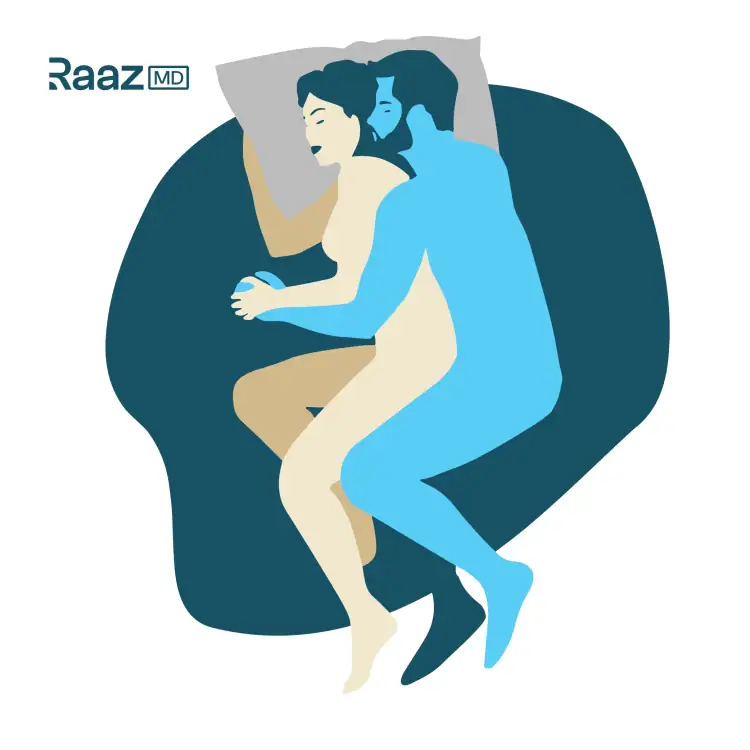
You both lie on your sides, facing the same way, with you behind your partner. Movement is slow and shallow, and neither of you has to hold your weight.
Why it helps: it is one of the least tiring positions, so it suits men who feel exhausted after work, have back or knee pain, or carry extra weight. Your hands stay free to touch your partner, and you can stay pressed together even if firmness dips for a moment. It is also easy to guide yourself back in by hand without anyone moving.
2. Woman on top (cowgirl)
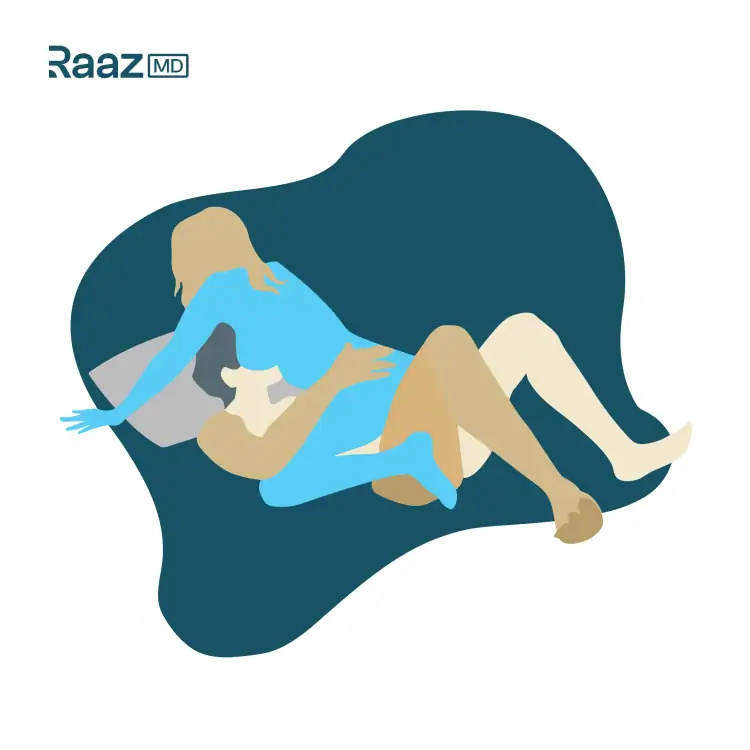
You lie on your back, perhaps with a pillow under your head, and your partner straddles you. She can sit upright or lean forward over you, and she controls the angle, depth and speed.
Why it helps: you do almost no work, so you can focus on sensation rather than stamina. Your partner can adjust the angle to keep you inside when you are not fully firm, and many women find this position more pleasurable because they can set the rhythm. Leaning forward also keeps you face to face for kissing.
3. Reverse cowgirl
This is cowgirl with your partner facing away from you, towards your feet. You still lie back and relax while she sets the pace.
Why it helps: like cowgirl, it takes the effort off you, and she can easily guide the penis by hand. What to watch: the penis bends at a less natural angle here, so go slowly, keep movements controlled and stop if anything hurts. It is a good position to try once you feel more confident, rather than the first one.
4. Lotus (seated face to face)
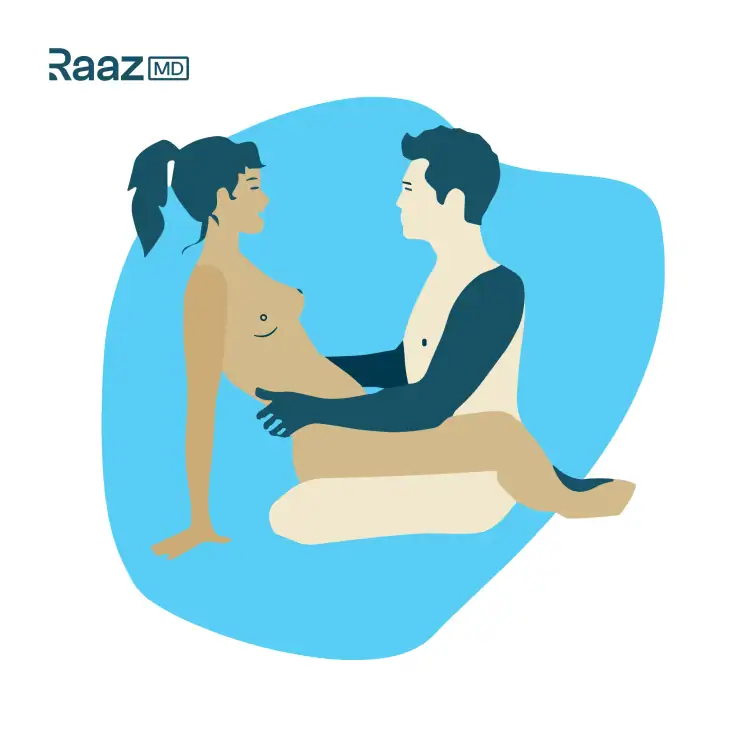
You sit on the bed with your legs crossed or stretched out, and your partner sits in your lap facing you, with her legs around your waist. The movement is more rocking than thrusting. It is sometimes called yab-yum.
Why it helps: this is the position with the most closeness. You are chest to chest, you can hold each other, kiss and look at each other. For men whose erection problems are driven by nerves, that intimacy is often more helpful than any technique, because it shifts the focus from performance to connection. Slow, deep breathing in this position can also calm the "will it work this time?" loop.
5. Kneeling
Your partner lies on her back with her hips resting on your thighs, and you kneel upright between her legs. A pillow under her hips can help.
Why it helps: you control depth without holding yourself up in a push-up, so your arms and back stay relaxed. Your hands are free to touch her and to guide yourself, and you can easily see and adjust. It is a comfortable middle ground for men who like a more active role but tire in missionary.
Comparing the positions at a glance
| Position | Why it can help | What to watch for |
|---|---|---|
| Spooning | Very low effort, lots of skin contact, easy to re-enter by hand | Shallow depth; not ideal if you want eye contact |
| Woman on top (cowgirl) | You relax while your partner controls pace and angle | Ask her to slow down if the penis slips out when not fully firm |
| Reverse cowgirl | Low effort for you; easy for her to guide by hand | The penis bends at a sharper angle, so go slowly |
| Lotus (seated) | Maximum closeness; eases performance anxiety | Needs some flexibility; movement is gentle, not vigorous |
| Kneeling | You control depth without push-up effort; hands free | Can strain the knees; use a soft surface or pillow |
| Man on top (missionary) | Familiar and intimate | Holding your weight is tiring and can drain focus |
| Doggy style | Good control for some men | Vigorous thrusting; linked to more penile injuries |
| Standing | Novelty | The hardest position to keep firm in; save for later |
A quick safety note
Penile fracture (a tear in the tissue of an erect penis) is rare, but it can happen when the penis slips out and is bent hard against the partner's body. A 2024 review of 490 cases found man-dominant positions (man on top and doggy style) were most strongly linked, though 120 cases happened with woman on top. With a partial erection, go slowly in every position. A popping sound, sudden pain, fast swelling or bruising needs emergency care the same day.
Why do you lose your erection when changing positions?
Usually because touch stops for a few seconds while you move, and anxiety fills the gap. High-effort positions, especially standing, make it harder too. If firmness fades in certain positions nearly every time, a blood-flow problem called venous leak is possible and worth checking.
This is one of the most common worries men bring to a doctor, and in most cases it is not a sign of anything serious. Here are the usual reasons.
The pause in stimulation
An erection is kept up by ongoing arousal. When you pull out, shift your legs and find a new angle, stimulation drops to zero for a few seconds. For a man whose erections are already borderline, that is enough for firmness to start fading.
Performance anxiety
The moment of switching is when the mind jumps in: "Is it going soft? What will she think?" That worry triggers stress hormones that tighten blood vessels, which works directly against an erection. A review in Sexual Medicine Reviews estimates that sexual performance anxiety affects 9 to 25% of men and is a major contributor to ED that has no physical cause. You can read more on how stress and performance anxiety affect sex.
Standing and high-effort positions
Standing, or holding yourself up for long, puts large muscles in your legs, back and arms to work. Blood is needed there, gravity pulls blood down, and your attention shifts to balance. Many men notice they are firm lying down and softer standing up. That pattern on its own is common.
Venous leak (position-dependent erectile dysfunction)
"Position-dependent erectile dysfunction" is a descriptive phrase, not a formal diagnosis. It simply means erections hold in some positions and fade in others. Most of the time the reasons above explain it. Occasionally, the cause is venous leak, where the veins of the penis do not close properly, so blood drains out and the erection cannot be held.
According to Cleveland Clinic, signs can include erections that fade quickly, being able to keep an erection only in certain positions, and ED medicines not working well. If that sounds like you, a doctor can assess you and may suggest a penile Doppler ultrasound, a painless scan that checks blood flow. Please do not self-diagnose; the fix depends entirely on what is found.
How can you stop losing your erection mid-sex?
Switch positions less often, keep touching while you move, use lubricant, go easy on alcohol before sex and keep stimulation going while the condom goes on. Pelvic floor exercises may also help some men over a few months.
- Switch less, and switch smart. Pick two positions you both enjoy and stay in each for longer. When you do change, choose moves that keep you close, such as rolling from cowgirl into spooning, instead of pulling out fully and starting again.
- Never let the touch stop. During a transition, your partner can keep a hand on you, or you can use your own. Think of it as a relay: stimulation passes from one position to the next without a gap.
- Keep stimulation going while the condom goes on. Many men lose firmness while fumbling with a condom. Keep one nearby and already opened, practise putting it on alone, and let your partner help or keep touching you while you roll it on. A well-fitting size also makes a real difference.
- Use lubricant. Dryness means more friction and more effort to enter, and effort drains arousal. A water-based lubricant makes everything smoother and more comfortable for both of you.
- Go easy on alcohol. A drink may relax you, but more than a little dulls the nerves and blood flow an erection needs. Our guide to alcohol and erectile dysfunction explains why.
- Slow down and widen the menu. Sex does not have to be only penetration. More foreplay, touch and oral sex take the pressure off and often bring the erection back on their own.
- Train your pelvic floor. The pelvic floor muscles help trap blood in the penis. In a randomised trial of 55 men with ED, pelvic floor exercises with lifestyle changes led to 40% regaining normal erectile function after six months, and another 35.5% improving. It was a small study, and exercises are no quick fix, but they are low-risk. Start with how to do pelvic floor (Kegel) exercises, then see our guide to pelvic floor and other exercises for erectile dysfunction.
Above all, treat it as teamwork. Tell your partner what helps before sex, not in the middle of it. A simple "If I soften when we switch, just keep touching me" removes most of the tension from the moment.
What is really causing your erection problem?
The same erection problem can come from very different root causes. Hormones, stress and sleep, habits and long-term health conditions all play a part, and finding your cause matters far more than any position.
At Raaz, we see this every day: two men describe the same symptom, and their reasons are completely different. The common ones are:
- Diabetes. High blood sugar damages the nerves and small blood vessels that erections depend on. Read more about diabetes and erection problems.
- High blood pressure and cholesterol. Both narrow and stiffen blood vessels, including the small ones in the penis. See how high blood pressure affects erections and the link with high cholesterol.
- Hormones. Low testosterone can lower desire and weaken erections, and thyroid problems can do the same. Know the signs of low testosterone in men.
- Smoking, gutkha and alcohol. Nicotine damages the lining of blood vessels over time. Learn how smoking causes erectile dysfunction and how gutkha and chewing tobacco harm erections.
- Stress, poor sleep and anxiety. Long working hours, money worries and short sleep lower testosterone and keep the body in "alert" mode, which blocks arousal.
- Nutrition. A diet heavy in fried food, sugar and refined flour feeds weight gain, diabetes and blood-vessel damage over the years.
This is why the same tablet for everyone does not work for everyone. If your problem is uncontrolled sugar or low testosterone, a new position will not fix it, but treating that cause often will.
Not sure what is behind your erection problem? Take the free Men's Test. It takes about 2 minutes, is completely private, and helps point to the likely cause from home.
Why can this feel harder for Indian couples, and what should you avoid?
Little privacy in joint families, rushed sex and pressure on newly married men all raise performance anxiety, which makes erections less reliable. Avoid neem-hakeem "power" pills and unregulated herbal products, and take ED medicines only on a doctor's prescription.
A lot of the advice online is written for couples with their own flat, a locked door and all the time in the world. Many Indian couples live differently:
- Little privacy. In a joint family, with thin walls and parents or children in the next room, sex is often quick and quiet. Rushing leaves no time for arousal to build, and being on edge about noise is its own kind of anxiety. Where you can, choose a time when the house is empty or asleep, and give yourselves longer than you think you need.
- Pressure after marriage. Newly married men often feel they must perform on the first night, with relatives hinting about "good news" soon after. One difficult night can turn into a cycle of fear and failure. Many couples take weeks or months to become comfortable with each other, and that is normal.
- Silence. Many men grew up hearing erection problems called "namardi", as though they said something about who you are. They do not. ED is a medical problem, like high BP, and it is treatable. Talking to your partner, and to a doctor, is a sign of care, not weakness.
- Heavy dinners and late nights. A big late meal, a few drinks at a wedding or party, and then sex at 1 am is a hard combination for any erection.
What to avoid: roadside "shahi dawakhana" ads, neem-hakeem "power" pills and unlabelled "herbal" or "ayurvedic" capsules that promise instant results. Some such products have been found to contain hidden prescription drugs in unknown amounts, which can be dangerous, especially with heart medicines. Genuine ED medicines such as sildenafil and tadalafil work well for many men, but they must be taken only on a doctor's prescription, because they are not safe for everyone (for example, with certain heart medicines called nitrates). Here is how sildenafil and tadalafil tablets work. For the cost of a doctor-led plan, see the current Raaz treatment plans.
When should you see a doctor?
See a doctor if erection problems happen most times you have sex, have lasted more than a few weeks, started suddenly, or come with other symptoms. Erection problems can be an early sign of heart disease or diabetes, so they are worth checking even if sex is otherwise fine.
Book a consultation if:
- you have trouble getting or keeping an erection more often than not
- the problem has lasted more than a few weeks
- it started suddenly, or after an injury, surgery or a new medicine
- you lose firmness in certain positions nearly every time, even with constant touch
- ED medicines have not worked, or you lose your erection even while taking them
- you also have very low sex drive, tiredness, or you have gained weight around the belly
- you have diabetes, high BP, high cholesterol or a family history of heart disease
- you get chest pain or breathlessness when you exert yourself, or numbness in the legs or groin
Get emergency care the same day for a suspected penile fracture (a pop, sudden pain, swelling or bruising) or an erection that lasts more than 4 hours and will not go down.
The good news is that a doctor can usually find the reason with a conversation and a few simple blood tests, and most causes can be treated.
How can Raaz help beyond changing positions?
Raaz connects you with a doctor by phone, works out the root cause of your erection problem and delivers any prescribed treatment discreetly to your home, along with lifestyle and stress guidance.
Positions can make tonight easier. Lasting change comes from treating what is behind the problem. With 50,000+ doctor consultations done, and "97% users saw results", Raaz MD is built for men who want real answers in private. Raaz has been featured in the Times of India, Economic Times, Mint, Zee Business, YourStory and Entrepreneur India.
- A doctor, not a sales script: your consultation looks at your health, habits and history.
- Root cause first: sugar, hormones, stress, habits or blood flow, so treatment fits you.
- Discreet delivery: any prescribed treatment arrives in plain packaging.
- Completely private: your details stay between you and your doctor.
You do not have to figure this out alone, or keep hoping the next position will solve it. Start with the free Men's Test: about 2 minutes, private, from your phone.
Frequently asked questions
Why do I lose my erection when I change position?
Most often because stimulation stops for a few seconds and anxiety rushes in while you reposition. Positions that need more effort, especially standing, can also make it harder to keep blood in the penis. If it happens nearly every time, or firmness fades quickly even with constant touch, a blood-flow issue such as venous leak is possible and worth checking with a doctor.
How do I stop losing my erection when switching positions?
Switch less often and keep contact while you move, using your partner's hand or your own. Choose transitions that keep you close, such as cowgirl to spooning, rather than pulling out fully. Go easy on alcohol before sex, use lubricant, and talk openly so the pause does not turn into pressure. If it keeps happening, get the cause checked.
What is position-dependent erectile dysfunction?
It is a descriptive term, not a formal diagnosis. Erections hold in some positions but fade in others, often when standing or when you are on top doing most of the work. Causes include effort drawing blood to large muscles, performance anxiety, or venous leak, where the penis cannot hold blood well. Treatment depends on which cause a doctor finds.
Which sex position is easiest for a man with erectile dysfunction?
Positions where you lie back or on your side and do less work tend to be easiest, such as woman on top (cowgirl) or spooning. Your partner controls pace and depth, you can keep touching each other, and there is less pressure to perform. No position is proven to improve erections themselves, so choose what feels relaxed for both of you.
Why do I lose my erection even after taking ED medicine?
Medicines such as sildenafil and tadalafil improve blood flow but still need arousal to work, and a heavy meal, alcohol or strong anxiety can blunt their effect. Some men need a different medicine or timing, which only a doctor should decide. If you lose firmness even on medicine, tell your doctor, as venous leak or low testosterone may be involved. Read how ED medicines like sildenafil work.
Can a man with erectile dysfunction still satisfy his partner?
Yes. Pleasure and closeness do not depend only on penetration or a fully firm erection. Touch, oral sex and positions that give your partner control can make sex satisfying for both of you. Honest conversation lowers the pressure that often makes erection problems worse, and treating the underlying cause often helps erections return.