Which position is best for premature ejaculation? No single position suits every man, but three help most: cowgirl with your partner on top leaning forward, spooning (lying on your sides) and the seated lotus. They cut how deep and how fast you thrust, keep your body relaxed and let your partner set a slower pace, so you last longer.
This guide ranks 7 positions from most to least helpful, names the ones that tend to speed things up, shows how to pair positions with simple in-the-moment techniques, and gives an honest read on the delay sprays, condoms and "timing" oils sold in India.
If your concern is keeping an erection rather than lasting longer, that needs a different approach. Read about sex positions for erectile dysfunction (a different goal) instead.
Which position is best for premature ejaculation?
For most men, cowgirl with the partner leaning forward is the best place to start, with spooning and the lotus close behind. The names matter less than what these positions share: slower, shallower movement that you are not the one driving.
The NHS suggests having sex with your partner on top for exactly this reason: it lets them pull away when you are close to climax (NHS: Ejaculation problems). You can lie back, breathe and focus on staying relaxed instead of setting the rhythm.
That said, bodies differ. A 2026 study of 119 men with premature ejaculation (PE) found that no single position was reliably linked to the longest or shortest time, even though the men did report clear differences between positions (Colonnello et al., International Journal of Impotence Research, 2026). So treat the ranking below as a starting point and notice what works for you.
Why some positions help you last longer
- Depth and friction: shallow, rocking movement stimulates the head of the penis less than long, deep strokes.
- Speed and who leads: when you drive the thrusting, arousal climbs quickly. When your partner leads, the pace is usually slower and easier to pause.
- Muscle tension: holding your body up on straight arms or standing tenses your thighs, buttocks and pelvic floor, and that tension pushes you towards climax. Lying back or on your side keeps these muscles loose.
- What you see: strong visual stimulation raises arousal. Positions with more closeness and less "view" are calmer.
- Ease of pausing: the best positions let you stop for a few seconds without awkwardness.
Why do you climax quickly in the first place?
Early climax usually has a cause: performance anxiety or stress, a very sensitive penis, thyroid or other hormone problems, habits like alcohol, smoking and gutkha, or simply inexperience. Positions buy you time in bed, but the cause decides what actually fixes it.
First, you are far from alone. 1 in 4 men struggle with ED and PE, and PE usually improves with the right help. The common causes are:
- Anxiety and stress: worry about performing, especially with a new partner or after a bad experience, speeds up the ejaculation reflex.
- Conditioning: years of rushed, secretive masturbation as a teenager (to avoid being caught) can train the body to finish fast. The NHS names this as one possible reason for lifelong PE.
- Hormones and thyroid: an overactive or underactive thyroid can cause PE, and so can other hormone imbalances.
- Habits and sleep: heavy drinking, smoking, gutkha and poor sleep all affect nerves, blood flow and stress levels.
- Other conditions: prostate inflammation, diabetes, and erectile problems themselves. Many men who worry about losing their erection rush to finish before it goes.
- Inexperience or long gaps: very common in the early days of marriage or after months without sex.
This is why the Raaz approach starts with the root cause. Two men can both say "I finish in under two minutes", yet one has a thyroid problem, another has anxiety, and a third has a weak erection he is racing against. Handing all three the same pill makes little sense. You can read more about premature ejaculation treatment and causes in our main guide.
Not sure what is behind it? Positions buy time, but the cause decides the fix. Take the free Men's Test: it takes about 2 minutes, it is completely private, and it helps pinpoint what is driving your early climax.
What are the 7 best sex positions for premature ejaculation?
These 7 positions are ranked from most to least helpful for lasting longer. The first few let your partner control the rhythm or keep movement shallow and slow. The last two work only if you deliberately keep the pace slow.
A tip that works across all of them: change position every couple of minutes. Each switch is a natural pause that lets your arousal drop a little before you carry on.
1. Cowgirl (partner on top, leaning forward)

How: you lie on your back and your partner sits astride you, then leans forward so her chest is close to yours, resting on her hands or forearms.
Why it helps: she controls the depth and speed, and leaning forward turns bouncing into a slow grinding movement. You carry no weight, so your muscles stay relaxed. She can also lift off for a few seconds when you signal.
PE tweak: agree on a simple signal, like a tap on the hip, that means "pause". Keep breathing slowly from your belly while she moves.
2. Spooning (side-lying)
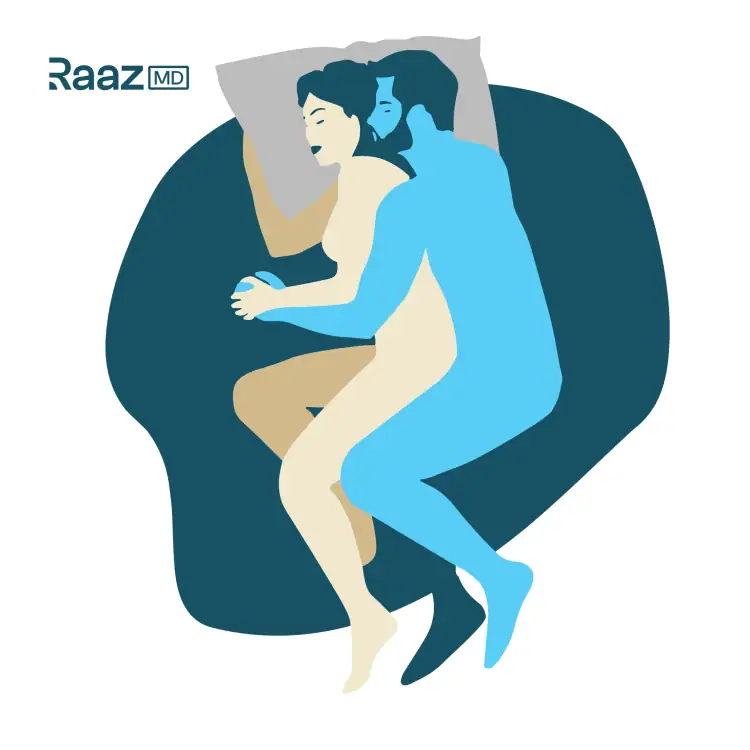
How: you both lie on your sides facing the same way, with you behind your partner, like two spoons in a drawer.
Why it helps: the range of movement is small, so thrusting stays shallow and slow. Nobody is holding their body up, there is little visual stimulation, and it feels close and unhurried.
PE tweak: stay inside and rock your hips gently instead of thrusting. Your hands are free to caress your partner, so her pleasure does not depend only on your movement.
3. Lotus (seated face-to-face)

How: you sit cross-legged on the bed or floor, and your partner sits on your lap facing you, wrapping her legs around your waist.
Why it helps: it is almost impossible to thrust fast here, so movement becomes a slow rock. Kissing, hugging and eye contact shift your focus from friction to closeness.
PE tweak: if things get too intense, simply hold each other still for a few breaths before you start moving again.
4. V-sit (seated on a chair, partner facing away)
How: you sit on the edge of the bed or a sturdy chair without armrests, and your partner sits on your lap facing away from you.
Why it helps: she sets the rhythm while your back and legs are supported, so you stay relaxed. The downside is that the view is more arousing than in the positions above.
PE tweak: ask her to keep the movement slow and circular. Hold her hips lightly so you can guide her to pause.
5. Reverse cowgirl
How: like cowgirl, but your partner faces your feet.
Why it helps: she still controls the pace, and you can lie back. Be honest with yourself, though: the angle and the view make this more intense for many men, which is why it sits lower on the list.
PE tweak: ask her to move slowly in small circles rather than up and down, and switch back to cowgirl if you feel close.
6. Grinding missionary
How: you are on top, as in ordinary missionary, but instead of long in-and-out strokes you stay inside and grind your pelvis in small circles. Rest your weight on your forearms, not on straight arms.
Why it helps: ordinary missionary is man-led and often fast, which is why it tends to end quickly. Grinding cuts friction on the most sensitive part of the penis while keeping close contact that many women enjoy.
PE tweak: take short breaks every minute or so. Staying on your forearms keeps your arms and back from tensing.
7. Bridge (kneeling)
How: your partner lies on her back with her hips raised on a pillow, and you kneel upright between her legs.
Why it can help: kneeling lets you control the angle, stop easily and use your hands on your partner. But penetration is deeper and you are leading, so it only helps if you keep it slow.
PE tweak: use it early, when arousal is lower, and move to spooning or cowgirl as you get closer.
All 7 positions at a glance
| Position | Who controls the pace | Depth | How much it helps with PE | Key tip |
|---|---|---|---|---|
| Cowgirl, leaning forward | Partner | Shallow to medium | High | Agree on a pause signal |
| Spooning | Shared | Shallow | High | Rock, do not thrust |
| Lotus | Shared | Shallow | High | Hold still and breathe |
| V-sit | Partner | Medium | Medium | Slow, circular movement |
| Reverse cowgirl | Partner | Medium to deep | Medium | Small circles, not bouncing |
| Grinding missionary | You | Deep but slow | Medium | Grind, rest on forearms |
| Bridge (kneeling) | You | Deep | Low to medium | Use early, keep it slow |
Which positions can make premature ejaculation worse?
Positions where you drive fast, deep thrusting usually speed up climax: mainly doggy style, fast standard missionary and standing positions. They are not off-limits, but slow right down or save them for when you feel more in control.
Research backs this up. In a 2025 survey of 1,904 men, doggy style was the most popular position overall. When they felt close to climax, men without PE were more likely to switch to shallower positions (27.1% versus 18%), while men with PE tended to move to deeper ones (Gül et al., Andrology, 2025). In other words, many men with PE do the opposite of what helps.
- Doggy style: deep, fast and fully man-led, with strong visual arousal.
- Fast missionary on straight arms: your arms, back and buttocks are tensed, and you set a quick rhythm.
- Standing positions: your legs and core work hard to hold you up, and it is awkward to pause.
The practical rule is simple: the moment you feel close, switch to spooning or cowgirl rather than going deeper.
How do you combine positions with the stop-start and squeeze techniques?
Use a partner-led position and, when you feel close, either stop all movement until the urge fades (stop-start) or firmly squeeze the head of the penis for 10 to 20 seconds (squeeze). Then carry on. Slow belly breathing makes both work better.
The stop-start technique, in short
- Start in cowgirl or spooning, where pausing is easy.
- When you feel you are about 7 out of 10 on the arousal scale, signal your partner and stop moving completely.
- Wait 20 to 30 seconds until the urge settles.
- Start again. Repeat three or four times before you allow yourself to finish.
The squeeze technique, in short
- When you feel close, withdraw.
- You or your partner firmly squeeze the penis just below the head, where it joins the shaft, for 10 to 20 seconds, as the NHS describes.
- Wait about 30 seconds, then continue.
Both techniques take practice, ideally first during masturbation and then with your partner. For the full step-by-step stop-start and squeeze guide, see our home remedies article.
Switching positions and slow breathing in the moment
Shallow, fast breathing is part of the rush towards climax. Slow belly (diaphragmatic) breathing calms the nervous system: breathe in through your nose for about four counts so your belly rises, then breathe out for about six counts.
This is not just folk advice. In a 2025 randomised trial of 62 men with PE, all men did behavioural therapy and pelvic floor training for 8 weeks, and the group that also practised diaphragmatic breathing daily improved more and held on to their gains a year later (Erkut et al., Journal of Sexual Medicine, 2025).
What else helps you last longer?
Regular pelvic floor (Kegel) exercises over a few weeks, yoga and breathing practice, and talking openly with your partner all improve control. They work best alongside the right positions, not instead of them.
Kegel exercises
The pelvic floor muscles are the ones you use to stop the flow of urine midway. Strengthening them gives you more control over the ejaculation reflex. Results take weeks, and they tend to be better when combined with breathing and behavioural techniques. Here is how to do Kegel exercises for premature ejaculation correctly.
Yoga and breathing
Poses that stretch the hips and strengthen the core, together with pranayama, lower stress and improve body awareness. See our guide to yoga and breathing to delay ejaculation.
Talking to your partner
Every tip in this article is easier when your partner is on your side. Most partners care far more about closeness than about minutes, and a pause signal only works if you have agreed on it. Here is how to bring this up with your partner without awkwardness.
A few more small things
- Some men last longer if they masturbate an hour or two before sex, which the NHS also mentions.
- Give foreplay more time, so your partner's pleasure does not depend only on penetration.
- Do not use alcohol as a fix. It may dull sensation, but it weakens erections and quickly becomes a crutch.
Do delay sprays, condoms or Ayurvedic oils sold in India work?
Numbing sprays and thicker or delay condoms can help some men last a little longer by reducing sensitivity. Most Ayurvedic "timing" oils and capsules sold online have no good-quality evidence, and some unregulated products have been found to contain heavy metals.
Delay sprays and creams
These contain a local anaesthetic such as lidocaine or prilocaine. The NHS lists them as an option, but warns they can transfer to your partner and numb her too. Use a small amount, follow the pack instructions on waiting or wiping off, and stop if you lose your erection or notice irritation.
Delay and thicker condoms
Any condom reduces sensation slightly. In the 2026 study mentioned earlier, men with PE reported lasting significantly longer when they used a condom. Thicker condoms, and "delay" condoms with a mild numbing gel inside the tip, reduce it further. They are cheap, low-risk and also protect against infections and pregnancy.
Ayurvedic timing oils, capsules and roadside clinics
Chemist shelves and online stores are full of "timing" capsules and oils promising hours in bed. Very few have been tested in proper trials. There is also a safety concern: a study in JAMA found that about one in five Ayurvedic products bought online, both US-made and Indian-made, contained detectable lead, mercury or arsenic (Saper et al., JAMA, 2008). Regulators in several countries have also found some "herbal" sex products secretly laced with prescription drugs.
The same caution applies to roadside clinics and neem-hakeem setups advertising cures for "gupt rog" (sexual health problems). Expensive "courses", scary talk about weakness from nightfall or masturbation, and "100% permanent cure" promises are warning signs, not treatment.
| Option | How it works | What the evidence says | Watch out for |
|---|---|---|---|
| Delay spray or cream | Numbs the head of the penis | Can help; listed by the NHS | Numbing your partner, loss of erection |
| Thick or delay condom | Reduces sensation | Men with PE report lasting longer | Less comfort for some men |
| Ayurvedic timing oils and capsules | Varies, often unclear | Little good-quality research | Heavy metals, hidden drugs, wasted money |
| Roadside "gupt rog" clinics | Unlabelled mixtures | No reliable evidence | High fees, fear tactics, unknown ingredients |
Privacy, early marriage and joint families
Many Indian men first face this in the early months of marriage. There is pressure to perform, the couple may barely know each other, and in a joint family there may be thin walls and little privacy. Sex becomes quick and quiet, and the body learns to finish fast.
None of this means something is wrong with you. Where you can, create unhurried time together, even a night away, and use the slow, quiet positions above. Spooning in particular suits a home where you would rather not make noise.
When should you see a doctor for premature ejaculation?
See a doctor if you climax too early most times you have sex, if it has gone on for several months, if it is causing distress or tension in your relationship, or if it started suddenly after years without problems.
Also get checked if you have trouble getting or keeping an erection, pain when you ejaculate, or symptoms like weight loss, a racing heart or tiredness that could point to a thyroid problem.
A doctor will first look for the cause. That can mean a few questions about your history, blood tests such as thyroid function, and checking for erection problems or prostate inflammation. Depending on what they find, treatment may include:
- counselling or psychosexual therapy, alone or with your partner
- structured behavioural techniques and pelvic floor training
- medicines such as dapoxetine or certain SSRIs, only on a doctor's prescription
- a prescribed numbing cream or spray
- treating erectile dysfunction first, if that is part of the picture
Please do not buy PE tablets online without a prescription. They are not right for every man, especially those with heart, liver or kidney problems or who take other medicines. If you are unsure where to start, read which doctor to consult for PE, or go back to our guide on treatment options for premature ejaculation.
The bottom line: the right position really can help you last longer tonight. Start with cowgirl, spooning or the lotus, keep the pace slow, and switch or pause when you feel close. But positions manage the symptom. If early climax is a regular pattern, the lasting answer lies in finding out why it happens.
Raaz MD has 50,000+ doctor consultations behind it. Take the free, private Men's Test to understand what is behind your early climax. It takes about 2 minutes, and a doctor can then build a plan around your root cause.
Frequently asked questions
Do sex positions alone cure premature ejaculation?
No. The right position can help you last a little longer in a single session, mainly by reducing depth, speed and muscle tension. It does not treat what is causing the problem, such as anxiety, a hormone or thyroid issue, or high penile sensitivity. If you climax too early most times you have sex, use positions alongside treatment of the root cause, not instead of it.
Why do I ejaculate faster in some positions?
Positions change how deep and fast the thrusting is, how much of your body is tensed, and how much you see and touch your partner. Deep, fast, man-led positions such as doggy style raise arousal quickly. A 2025 survey of 1,904 men found that men with PE tended to move to deeper positions near climax, while men without PE switched to shallower ones.
How can I stop premature ejaculation immediately?
In the moment, slow down or stop completely when you feel close, switch to a position where your partner controls the pace, and breathe slowly from your belly. The squeeze technique can also settle the urge within seconds. These buy you time tonight, but lasting improvement usually comes from regular practice and, where needed, treatment a doctor recommends.
Does a condom help with premature ejaculation?
It can, a little. Condoms reduce sensation, and a 2026 study of men with PE found they reported lasting longer with a condom. Thicker or delay condoms, some of which contain a mild numbing gel, reduce sensitivity further. They are a sensible, low-risk thing to try, but they do not fix the cause, and some men find thick condoms less comfortable.
Is premature ejaculation normal the first time?
Yes, it is very common. Climaxing quickly during your first few experiences, with a new partner, or after a long gap usually comes from excitement and nerves rather than a medical problem. It often settles as you relax and gain experience, including in the first months of marriage. If it keeps happening after several months of regular sex, it is worth getting checked.
Are delay sprays safe to use?
Numbing sprays and creams with a local anaesthetic are generally safe when used as directed, and the NHS lists them as an option. Use only a small amount and follow the pack on waiting or wiping off, because they can numb your partner too, and too much can soften your erection. Buy from a licensed chemist, avoid unlabelled products, and ask a doctor if unsure.